Since Descartes the dualism between mind and body had been framed in laws of physics on the one hand, and the reason of the mind on the other. This distinction stays in large terms true, but there is a shift to make an even finer distinction between what is going on in the conscious (meta-physical) part of the equation. One prominent modern representative of this new understanding is Habermas. He develops his concept of the life-world in contrast to traditional rationality with its logical mechanics of reason (Luh). Habermas’ life-world can be related to philosophic notions of liberalism and individualism; schools that focus on the non-rational causality of interest or pleasure. The distinction is based on the observation that one can not argue for the pleasure or interest of others. One can only know by oneself whether one enjoys or is interested in something. This is different from objective reason and leads us to the notions of inter-subjective reason. The life-world concept thereby splits the Cartesian mind into a subjective-reason and inter-subjective-reason. Both valid and relevant.
Similarly the virtual space created by the internet creates a middle form between constructed reality and existence, which has been dubed “society frozen” (Sassen), alluring to the fluidity of the continuous emergence of the human/social condition and the fact that in a virtual scenario all states are recorded as fixed (frozen). In many ways this is simply a development from earlier forms of meta-physical virtuality – as in books or newspapers – but the technical virtual representation of realities (ideas) has a certain co-relation with Habermas’ life-world as there is no rational why someone chooses to represent himself in a certain way in a virtual environment but through the virtualisation the choice becomes existence (facts) thereby the Cartesian dualism is transformed into a trinity: The physical, the meta-physical, and the virtual. Tertium datur est.
Tuesday, March 27, 2007


Monday, March 26, 2007
Microsoft and revolutionary user interfaces?
I just read an interview with a spanish researcher who works for M$ and mentioned MS Seadragon as a revolution in user interfaces. So I went and checked it out: The idea is to have frictionless zooming in and out of interfaces so that you can have a really big desktop and zoom in and out of the various tasks you have running, or a big document and jump pages without need for reload. The promises is really big:
1. Speed of navigation is independent of the size or number of objects.
2. Performance depends only on the ratio of bandwidth to pixels on the screen.
3. Transitions are smooth as butter.
4. Scaling is near perfect and rapid for screens of any resolution.
and the performance of the beta viewer still very buggy. At least on my mashine it dod not produce good results neither with Firefox nor with Explorer.
Nevertheless i will keep an eye on it as the idea is really powerfull.
1. Speed of navigation is independent of the size or number of objects.
2. Performance depends only on the ratio of bandwidth to pixels on the screen.
3. Transitions are smooth as butter.
4. Scaling is near perfect and rapid for screens of any resolution.
and the performance of the beta viewer still very buggy. At least on my mashine it dod not produce good results neither with Firefox nor with Explorer.
Nevertheless i will keep an eye on it as the idea is really powerfull.
Friday, March 23, 2007
Optimism for Open Metaverse
There is much discussion about the fact that most virtual worlds - including the flag-ship second life - run on proprietary non-standardized code. The netizen community is of course horrified by the fact that single companies have despotic power over their metaverses, but are we really doomed to remain in proprietary virtual worlds?
I don’t think so. There are open source efforts to create virtual worlds - e.g. croquet and the very Linden Labs (after already having open-sourced the client) are now openly supporting a roadmap for open source development of their server code base. I quote:
Unfortunately i don’t have the reference at hand, but i remember reading about an interview with Linden Chief Mr. Rosedale (the man who we will probably have to remember as causing the huge media hype and capitalist hoax about SL which gave SL the critical user mass to flourish), where he stated that Lindens mid/long-term plan is to turn their business into top-notch consultancy regarding the creation and maintenance of virtual worlds run by other enterprises. I believe all they do is build up their brand value (reputation) and intend to position themselves as the Linus Torvals of the VR code (see post referenced above).
In conclusion, (and I sincerely hope i am not being proven wrong but) i perceive Linden as a smart crew, open sourcing their creation, while still intending to steer it to a certain degree; thereby they might be able to develop a solid business model for large-scale open source projects (with leadership).(1)
(1) Linux to a certain degree represents the only proven business model () and the fact that it still hasn’t made it to more than 5% market share even though they have really substantial cost advantage, tells me that there is still something not-convincing about that model.
Other open source community based projects like moodle are of course really ethical efforts and their output is amazing, but one has to see that they only work because they are in-directly (and in fact un-consciously) subsidized by the state through professors (and students their students) who invest their work time in them. Nevertheless this model is IMHO completely feasible for many applications. (But for better or worse outside the capitalist market and therefore constrained by other variables.)
I don’t think so. There are open source efforts to create virtual worlds - e.g. croquet and the very Linden Labs (after already having open-sourced the client) are now openly supporting a roadmap for open source development of their server code base. I quote:
8<----snippet from a dialoge on SL Edu list>
Actually, if you want to work with Linden Lab, the best place to go is here: https://wiki.secondlife.com/wiki/Open_Source_Portal
OpenMetaverse uses Linden Lab technology, but is not affiliated with
Linden Lab. .. but LL control the roadmap and want to determine the protocols,
We control the roadmap in a way not unlike Linus Torvalds controls the Linux kernel, Mozilla Foundation controls Firefox, and MySQL AB controls MySQL. We're still relatively new at this, so it's going to take time for us to get good at it, but we'll get there.
8<--------snippet from a dialoge on SL Edu list>
https://lists.secondlife.com/pipermail/educators/2007-March/007555.html
Unfortunately i don’t have the reference at hand, but i remember reading about an interview with Linden Chief Mr. Rosedale (the man who we will probably have to remember as causing the huge media hype and capitalist hoax about SL which gave SL the critical user mass to flourish), where he stated that Lindens mid/long-term plan is to turn their business into top-notch consultancy regarding the creation and maintenance of virtual worlds run by other enterprises. I believe all they do is build up their brand value (reputation) and intend to position themselves as the Linus Torvals of the VR code (see post referenced above).
In conclusion, (and I sincerely hope i am not being proven wrong but) i perceive Linden as a smart crew, open sourcing their creation, while still intending to steer it to a certain degree; thereby they might be able to develop a solid business model for large-scale open source projects (with leadership).(1)
(1) Linux to a certain degree represents the only proven business model () and the fact that it still hasn’t made it to more than 5% market share even though they have really substantial cost advantage, tells me that there is still something not-convincing about that model.
Other open source community based projects like moodle are of course really ethical efforts and their output is amazing, but one has to see that they only work because they are in-directly (and in fact un-consciously) subsidized by the state through professors (and students their students) who invest their work time in them. Nevertheless this model is IMHO completely feasible for many applications. (But for better or worse outside the capitalist market and therefore constrained by other variables.)
Tuesday, March 20, 2007
Second Life: critique and tolerance
Below you find some short arguments which I just wrote in a critical email to a friend who sent me his euphoric sales pitch for Second Life (SL). Subsequently i delve into a short cultural reflection about how important tolerance is for bootstrapping thus taking up the cudgels for Second Life and paying respect to their accomplishments.
Having communicated what IMHO is the current infancy conditions for setting up an SL island (or other venture), while i believe I also outlined the immediate and potential benefits, I feel obliged to pay my respect to the Linden Labs team and everybody who is participating in the realization of the potential by creating this fascinating new world.
Virtual reality is a theme in science fiction for many many years and first attempts to realize this vision have been conducted with various success since the creation of the internet. Hence SL is nothing new as such. BUT SL is the best 3-dimensional cyberspace i have come across so far, AND maybe more important. they have managed to create such a media fuzz around their project that it seems there is a critical mass of users and enough interest from investors and organizations that invest in SL presences that there is enough capital to really boost development and hopefully solve many of the technological problems now present.
So in conclusion it is always difficult to do the splits (find the equilibrium) between being critical (as in enlightened or not-naïve) while tolerating some flaws, and SL surely needs a good dose of both. Whether Second Life as a virtual world developed and run by Linden Labs has a promising future i am critical; That the 3D web is there to stay and that it is very valuable to invest time and money in understanding and exploiting it I am even more convinced.
----------------------------------------------------------------
Thomas Praus, Peter Bihr and myself (a.k.a. MaPeTo) are lately exploring and discussing about SL and virtual worlds. Peter has published his evaluation of the current opportunities and limitations of SL and Thomas will shurely do so very soon.
1) Don't lure them into developing an island by using inflated numbers: I would be very cautious to present the user growth rate with 30% for the 2007 forecast. I don’t think it will continue at that speed. It was a nice media-virus for some month now, but as 'real SL development' with 'real benefits' is much slower I believe it will stabilize and turn to an organic growth.
SL and virtual worlds in general have some very potent value propositions but right now the biggest benefit to create a subsidiary is: marketing/branding: to communicate a) that the organization is a pioneer and b) whatever the SL offer potentially is. I say potentially because it is almost impossible to really fulfill the expectations.
Allow me to elaborate: Take the case of a car-maker who sets up an SL race-course to allow users to "try" a new model. Everybody who actually tries the car in SL will be disappointed because we are used to high-end racing games (need-for-speed, etc.) and in comparison the SL experience is really devastatingly bad. However i believe it is only a matter of time until the 3D web will be able to have people test-drive really good simulations of cars (potentially through the virtual representation of their own neighborhoods). Before that happens at least two conditions have to change: server-infrastructure (connection and resulting graphic) problems have to be taken care of and the know-how of racing-game specialists has to be incorporated. Once we are there i believe it is quite realistic that virtual-world-car-selling becomes a decisive aspect of marketing and selling cars. Will the company that has developed a long term experience in using virtual worlds have an advantage against its competitor who neglected the new medium? Without a doubt.
2) do not forget that in this moment only 40 people can be at an island simultaneously so SL internal out-reach is quite limited. (Of course the solution is to really market the SL footage in traditional media). Another important point seems to me that an entity that runs an island should plan for in-world-representative(s) (and the additional monthly cost). Given that SL is accessed by people from around the world a representative would ideally need to be there 24/7 and speak at least the organizations 'normal' languages. There is technology that communicates to Real Life (through messaging) when someone comes to your island. However this does not solve the 24/7 issue.
Having communicated what IMHO is the current infancy conditions for setting up an SL island (or other venture), while i believe I also outlined the immediate and potential benefits, I feel obliged to pay my respect to the Linden Labs team and everybody who is participating in the realization of the potential by creating this fascinating new world.
Virtual reality is a theme in science fiction for many many years and first attempts to realize this vision have been conducted with various success since the creation of the internet. Hence SL is nothing new as such. BUT SL is the best 3-dimensional cyberspace i have come across so far, AND maybe more important. they have managed to create such a media fuzz around their project that it seems there is a critical mass of users and enough interest from investors and organizations that invest in SL presences that there is enough capital to really boost development and hopefully solve many of the technological problems now present.
So in conclusion it is always difficult to do the splits (find the equilibrium) between being critical (as in enlightened or not-naïve) while tolerating some flaws, and SL surely needs a good dose of both. Whether Second Life as a virtual world developed and run by Linden Labs has a promising future i am critical; That the 3D web is there to stay and that it is very valuable to invest time and money in understanding and exploiting it I am even more convinced.
----------------------------------------------------------------
Thomas Praus, Peter Bihr and myself (a.k.a. MaPeTo) are lately exploring and discussing about SL and virtual worlds. Peter has published his evaluation of the current opportunities and limitations of SL and Thomas will shurely do so very soon.
Sunday, March 18, 2007
Machinima (in Second Life)
"Machinima a portmanteau of machine cinema or machine animation" is the art of making movies recording activities within a game or other virtual environment.
There is a portal with hundreds of recordings www.machinima.com. One example of what this results in is "Out of my skin" the first entry of a second life series/diary:
There is a portal with hundreds of recordings www.machinima.com. One example of what this results in is "Out of my skin" the first entry of a second life series/diary:
Saturday, March 17, 2007
Simpsons on the tube
Last night I was introducing the kid of a friend of mine to the wonders of the net. His first google question was "cool online games" ;-)
After some funkey jump & run we looked at how homer and his folks broadcast themselves and we found some really innovative footage:
and then later on that night i ran into this one which i also enjoyed
After some funkey jump & run we looked at how homer and his folks broadcast themselves and we found some really innovative footage:
Live action Simpsons
and then later on that night i ran into this one which i also enjoyed
smokin homer simpson
digital ethnography & cutting edge sixties
Text is linear by Prof Wesch
is really a great visualization of the change from physical-analog-linear to virtual-digitally-hyperlinked
http://mediatedcultures.net/ksudigg/?p=78
Prof Wesch is working on digital ethnography and in my opinion this is an excellent marketing piece, communicating the relevance and triggering the interest of potential students. Here are some more videos of that course - http://mediatedcultures.net/ksudigg/?cat=4
Powers of Ten
A film dealing with the relative size of things in the universe - and the effect of adding another zero. I dont remember where i read it but i think this movie was shot by IBM in the sixties and that makes it a truly cutting edge piece
http://video.google.com/videoplay?docid=6945724039283018435
is really a great visualization of the change from physical-analog-linear to virtual-digitally-hyperlinked
http://mediatedcultures.net/ksudigg/?p=78
Prof Wesch is working on digital ethnography and in my opinion this is an excellent marketing piece, communicating the relevance and triggering the interest of potential students. Here are some more videos of that course - http://mediatedcultures.net/ksudigg/?cat=4
Powers of Ten
A film dealing with the relative size of things in the universe - and the effect of adding another zero. I dont remember where i read it but i think this movie was shot by IBM in the sixties and that makes it a truly cutting edge piece
http://video.google.com/videoplay?docid=6945724039283018435
Monday, February 26, 2007
Collabowriting an Institupedia to enable cothink
Recently i came across Nobel laureate Herb Simon and his ideas about how science should be creative. He basically believes that it is much more productive to create reality rather than to research the 'pure' existence. More straight forward he thinks that when we try to create something - let's say a rocket that flies to the moon - we will learn a lot during the process of the construction; we might not have understood 100% what and why things are happening but at least we have "mastered" a challenge and can reap the benefits. In comparison when we start out to understand and describe gravity, we might investigate for a long time, generate a lot of "knowledge" but can not exploit it. [please excuse the outrages simplification of Simon's thinking]
Having that said, I believe that, as words replace matter in the meta-physical world, the creation of new words is the essence of Simonian social science. So without further delay allow me to propose three new words: Collabowriting, Institupedia and cothink.
Collabowriting is the most straight forward of the three and its significance should be easy to decifer as it is a simple combination of the word collaborate and write to describe the practice of writing a document together. Collabowriting has been possible long before the advent of wikis and other IT collaboration tools, but the practice of jointly letting a document emerge was much less dovetailed and with less interaction. So true collabowriting is a rather recent phenomenon and most of us are still rather stone-age when it comes to doing it efficiently.
Institupedia is inspired by the popular encyclopedia wikipedia, which uses the collabowriting tool wiki to create an open encyclopedia on the internet. Following Wittgestein's claim that all thinking and human being originates in words, I suggested during my time at UNDP as well as in my university UOC to create an institutional enceclopedia in order to allow for collective and discursive definition of the institutions vocabulary. After i received an invitation to attend a webinar on "Ways to create an internal “Wikipedia” inside your company
There is several reasons why an institupedia (UNDPedia, UOCipedia, etc.) helps to create an enabling environment, and i plan to elaborate on that in due time. For now allow me to cherry pick just one: Cothink is a literal translation from the German term "mitdenken" that my dictionary translates as: 1. show some initiative, think (things through); 2. [please cothink!] help me (oder us) think; 3. follow someone's train of thought.
In general i would claim that cothink happens when an individual identifies to some degree with the scenario and thus applies his being to the situation. Two conditions have to be met to enable cothink: (a) the individual has to be motivated to help (team spirit etc. come to mind) and (b) the person needs to know / have information about the scenario. Developing an institupedia where the emerging plans, projects etc. are defined will enable at least the latter condition and probably contribute to the former as a positive spiral can be triggered.
Tuesday, February 20, 2007
Giddens - A call to arms (for sociologists)
Anthony Giddens published a short opinion piece reflecting upon the question "why isn't sociology again right at the forefront of intellectual life and public debate?" (guardian - http://commentisfree.guardian.co.uk/anthony_giddens/2006/11/post_682.html).
There are some interesting arguments. I especially agreed:
"A little bit more utopian thinking might help too - well, why not? Politics in some ways has become deadly dull. We need more positive ideals in the world, but not empty ones - rather, they should be ideals that link to realistic possibilities of change."
And some lines above he says:
"There are no longer utopian projects that would supply a source of direction for social reform and a source of motivating ideas. I'm not saying that sociology was ever itself a form of utopianism. But sociological thinking, born of the political and economic revolutions of the 19th century, certainly was regularly stimulated by an engagement with those who wanted to change the world for the better."
As you know i am all up for creating utopian ideals to strive for.
One i just recently came across:
technocratic movement - http://en.wikipedia.org/wiki/Technocratic_movement
From my reading it seems to be true that technocracy (as they describe it) is wrongly negatively connoated; I dont really see why technocracy should be incompatible with humanism (http://en.wikipedia.org/wiki/Humanism)
The chilenian 'socialist internet' project (1970-73) appears to me to have been an socio-technocratic experiment
--> http://en.wikipedia.org/wiki/Project_Cybersyn
There are some interesting arguments. I especially agreed:
"A little bit more utopian thinking might help too - well, why not? Politics in some ways has become deadly dull. We need more positive ideals in the world, but not empty ones - rather, they should be ideals that link to realistic possibilities of change."
And some lines above he says:
"There are no longer utopian projects that would supply a source of direction for social reform and a source of motivating ideas. I'm not saying that sociology was ever itself a form of utopianism. But sociological thinking, born of the political and economic revolutions of the 19th century, certainly was regularly stimulated by an engagement with those who wanted to change the world for the better."
As you know i am all up for creating utopian ideals to strive for.
One i just recently came across:
technocratic movement - http://en.wikipedia.org/wiki/Technocratic_movement
From my reading it seems to be true that technocracy (as they describe it) is wrongly negatively connoated; I dont really see why technocracy should be incompatible with humanism (http://en.wikipedia.org/wiki/Humanism)
The chilenian 'socialist internet' project (1970-73) appears to me to have been an socio-technocratic experiment
--> http://en.wikipedia.org/wiki/Project_Cybersyn
Friday, February 09, 2007
brainfood selection 01
allow me to recommend two wired articles that caught my eye and made me believe technological progress once more:
Apparently (americans please excuse my european ignorance) internet based mobile phone services are already widely available in the States and they make communication decisively cheaper once again. In the wired article they are testing services for around 20$ a month offering unlimited calling some of them even to selected european countries. Unbelieveable but it really seems well talk for a low flat fee with all the world soon.
Also a guy was awarded a patent for a huge 35 m diameter baloon covered by millions of LEDs making the airship the biggest spherical screen ever - check out the pix @
http://blog.wired.com/gadgets/2007/02/video_airship_p.html
Apparently (americans please excuse my european ignorance) internet based mobile phone services are already widely available in the States and they make communication decisively cheaper once again. In the wired article they are testing services for around 20$ a month offering unlimited calling some of them even to selected european countries. Unbelieveable but it really seems well talk for a low flat fee with all the world soon.
Also a guy was awarded a patent for a huge 35 m diameter baloon covered by millions of LEDs making the airship the biggest spherical screen ever - check out the pix @
http://blog.wired.com/gadgets/2007/02/video_airship_p.html
Thursday, February 08, 2007
Fussball
Eine freundin von mir baut zusammen mit ihrem Bruder das Fussball-Portal http://www.nordostfussball.de/ auf. Dort findet ihr top aktuelle Nachrichten und Reportagen zu allem was Fussballfans im Norden Deutschlands interessiert.
Wednesday, February 07, 2007
DRM or no DRM - that's the question
this morning a friend send me this:
> Mark my words. this is the day, when DRM died:
>
> http://www.apple.com/hotnews/thoughtsonmusic/
> Open letter from Steve Jobs about how much DRM sucks, and that media
> should be unprotected.
>
> well written too
which made me - after reading and agreeing that it seemed quite a move - forward the message to some friends and bang i got some brisk critical feedback which i post as comments to this entry.
I recommend you to read Steve Jobs before you read the comments.
My 2 cents:
1) Apple is a really really street smart company and yes they are 'manipulating' consumers just as (or maybe a bit better than) the other big MNCs.
2) As long as they are playing in my direction i wont write a rant about it
3) I own an iPod and i have very mixed feelings - sort of a hate-love relationship. I only once ran into DRM issues (buying for the first and last time from audible) which i duly solved myself ;-)
so my conclusion is:
I don’t agree with dAn à all consumers hate DRM and the industry will not succeed in pushing it out so it is dominant.
I do agree with Micha – it is just a marketing communication fad (cluetrain manifesto style) and apple likes their profit more than their customers. However apple is among the few companies that are already playing with and seriously valuing their customers.
Tuesday, February 06, 2007
Best language school in Barcelona
In my constant search for spending my time with worthwhile activities, i consult my good friend Jan de Lassen (cool site with his pictures) who is a painter and who just recently opened the doors of what will be the best language school in Barcelona Spain - diloga. Jan's technique is really usefull and efficicent in braking the ice and actually make you speak. The school is located in one of Barcelonas best neighborhoods - Gracia - where you find small spanish plazas and an excellent street- & night-life .
For me it is a great opportunity to gather some hands on experience in entrepreneurship and get to work with really nice people!
For me it is a great opportunity to gather some hands on experience in entrepreneurship and get to work with really nice people!
Wednesday, January 31, 2007
Second Life in 3D
just stumbled across the following news:
spotted the news on http://www.nmc.org/sl/2007/01/30/3d-viewer/The University of Michigan 3D Lab has brought Second Life one step closer to real life by developing stereoscopic support for the Second Life viewer. This recent addition allows visitors wearing special glasses to see the objects of Second Life pop out of the screen similar to watching a 3D movie.
Using the recently released source code by Linden Labs, Gabriel Cirio and Eric Maslowski have developed a stereoscopic version of the Second Life viewer that works with a large-screen stereo projection system. This low-cost system uses passive stereo based on polarizing filters and was built from off-the-shelf components.
The University of Michigan 3D Lab is continuing development of their Second Life viewer, as well as other projects related to Second Life and Virtual Reality. For more information contact “um3d-secondlife[at]umich.edu” or visit http://um3d.dc.umich.edu/.
Wednesday, January 17, 2007
Democracy, Nietzsche and Higher Education
I have expressed my disillusion and mounting disrespect for what has become of democracy in our days. On various occasions I have argued that a meritocracy (wikipedia entry), or what Plato described as the wise philosophy king, would be a more rational and sustainable system. That is because a meritocratic leadership or wise king would not be as prone to populist opportunism and short term thinking (as is the case in our current state of affairs).
I lately come to revise this believe as I am (literally) listening to Nietzsche (sitting in the train with a recording of Zarathustra [german mp3 auf anfrage] on my iPod). Nietzsche, who detests the weak, declares that the übermensch, who is ‘beyond good and evil’ [english public domain audio-book], should engage in a constant good war, turns out to be the true ideological architect behind the Nazis. Nietzsche has reminded me about the superior power of the primeval human condition – self interest.
The rule of the majority - democracy - is the only cure (proven to work) against the egomaniac drives of all individuals. I still see all the flaws of the democratic rule we have, and I still believe that the weighting of influence according merit makes a lot of sense (and is actually already present to a certain imperfect degree), but the issue really is to have interested, educated and participating citizens in a democracy. And this is where I want to put the emphasis of this text and elaborate the argument for more ‘cultural citizenship’ (Delanty, 2001) education.
The phenomenon I want to critique is, that the trend to streamline education to the point where it is (only) effective vocational training, preparing people to perform a market demanded job, has gone so far as to cut and rationalize away most ‘cultural citizenship’ education. Because the programs are shorter, while having to transmit the same amount of disciplinary knowledge, there is arguably very little time for the students to engage in citizens education (developing informed opinion about political/axiological issues) and participation (organize and participate in constructive critical discourse).
If we follow the late capitalist tendency to have universities (and after that schools) serve the demands of the (free) market (ever faster training of oven-ready workers), while neglecting the demands of democracy, we will end up in a system where the most charismatic (read entertaining) and populist (read doing most for the majority instead of the smart) politician will win elections.
I believe that education must be a free public good implemented by autonomous institutions, which (next to delivering vocational training) engage citizens in learning about today’s pressing problems and foster their active participation in tackling them. Hence the implicit opinion that a) the WTO should not succeed in making education a globally tradable service just like any other but that b) it is the any nation states best investment to ensure good education and research. May they cut on military and police surveillance budgets for a change!
Highly recommended:
Delanty, G. (2001). Challenging knowledge : the university in the knowledge society. Buckingham [
Tuesday, January 16, 2007
starting a business in your Second Life
I just found a nice & short article by Laura Tiffany on entrepreneur.com, which introduces the virtual environment Second Life and reflects a bit about the abundant entrepreneurial opportunities present in this new business environment where people spend about 1’000’000 $ per day!
I especially agree on the importance of the following and question Laura poses: “But the bottom line for entrepreneurs is, will Second Life really pan out? Or is it just hype, since the majority of people have never ventured virtually or even heard of it?” Laura at least answers positively: “Your mom may never understand exactly what a 3D world is, or the point of an avatar. But enough other people do that a whole new class of entrepreneurs has been born to serve their needs.”
Sunday, January 14, 2007
Xmax mail 2006
I have the tradition of sending out a xmas mail to everybody i like to stay in touch with. It contains info about projects and brainfood i believe are really good. Here are the recommendations:
Open Educational Resources (OER)
I guess most of us agree that knowledge is the key to development. Open Educational Resources (OER) is a movement (supported e.g. by the UNESCO) that attempts to cooperate in a global alliance to provide teaching materials of all levels on an open source (no copyright) basis. Not only can everybody freely access e.g. video lectures but the idea is also to collaboratively continually improve e-learning materials. Amazingly even eminent universities especially the MIT (Open Courseware Project) but also e.g. Harvard have already bought in and have opened big chuncks of their content. If this really takes off it will be a good weapon against the global knowledge divide. My supervisor is the head of the UNESCO chair for e-learning at my university and we are actively trying to spread awareness and support these efforts, I’d be happy to get you involved.
It’s hype – but I like my Second life
When Second Life (SL) started it was a virtual world (a green floor, gravity and lighting) where you could walk around with a little avatar but there was nothing to see or do. But that changed. The clue is that the responsible Californian company allows you to create (/program) more or less everything you can think of. And people have created a fantastic world with flying islands, hip hop clubs, the US Congress (including virtual clones of some ‘I-was-there-first’ politicians who really show up to take their vote catching to the next level). I tell you I hardly ever touch any computer games but that is not a game, that is a virtual REALITY. Being the radical constructivist that I am, the real creative possibilities seem truly amazing. If you are not curious, no pasa nada! It is quite slow, the graphics are still very basic, and many (including me) are very cautious regarding the importance of commercialisation (the Reuters and the German Telecom just produced the first commercial Tabloid) and consumption present in this Second Life. But hey – does anybody still remember Mosaic or Netscape these were the first platforms that allowed for a completely new experience of the web and that is what I believe SL is. Hyped or not I had some fun hours in there and I will happily meet up with you and go on some excursions. User accounts are free and I recommend this Wired Travel Guide: Second Life
MakeZine & SocialEdge, AfriGadget and Kiva
Here come a number of InfoSpaces: MakeZine makes me dream of a better world in which people use their creativity and the other three show me that this world does actually already exist:
MakeZine’s slogan is IF YOU CAN’T OPEN IT YOU DON’T OWN IT. It is a great tinker & hacker magazine, complete with construction plans and sometimes with ‘do it your self’ packages and even beginner sets. I got a couple of the easy treats for xmas and it was great fun soldering and put to unintended use ;-) As nicely put on the SocialEdge blog: MakeZine is a blog full of things that I will probably never make, but that being said, it's nice to know that if I ever did need a personal submarine, I could make one out of a pig trough (no, I'm not joking).
@iPod owners: You have to check the iPod hacks page – there are do it yourself solarpanel chargers, software replacements that make you independent from Apple’s awful digital rights management… and the list goes on and on.
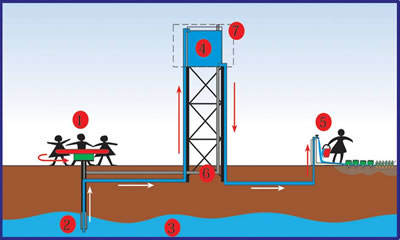
SocialEdge & AfriGadget are two blogs that implement the creative MakeZine spirit to sustainability and development. Both sites collect instances of social entrepreneurship & innovative technology application at its best. Here is one I liked best: One project that particularly caught my eye on the site was the "Playground Pump" ... a water pump that's generated from a children's playground merry-go-round
The Fountain
Big Fish
Volver
Vendetta
Frida
Campain for a Parlament at the United Nations
to facilitate the final preparations of the launch of the campaign for the establishment of a UN Parliamentary Assembly in April 2007 we have posted some *initial* information on the net. In particular, the text of the UNPA appeal is now publicly available in over 20 languages and may be signed online.
Please visit
http://www.uno-komitee.de/unpa/
Feedback and comments to improve the initial campaign pages are very welcome.
Please visit
http://www.uno-komitee.de/unpa/
Feedback and comments to improve the initial campaign pages are very welcome.
Monday, December 18, 2006
My personal View on Open Educational Resources
Here you find a short paper in which i try to outline my personal view on the potential and the challenges of Open Educational Resources (OER - a global alliance for collaborating and sharing teaching material).
I would love to elaborate and 'formalize' the thoughts presented in the paper and would be very interesting to do so in colaboration with someone.
I would love to elaborate and 'formalize' the thoughts presented in the paper and would be very interesting to do so in colaboration with someone.
Thursday, December 07, 2006
Gadget mania
I just discovered a nice source for the killer xmas wishlist: Digg's Tech-Gadgets. One of the first entries i came across was the "7 Home Gadgets You Can’t Buy", which contains some seriously desireable = beautyful and functional products .
Subscribe to:
Posts (Atom)