Disclaimer: I work in Google's Policy Team, developing multistakeholder cooperations for internet governance & policy themes, hence I want to point out that all the opinions and ruminations on this blog are mine, not Google's.


Showing posts with label cyberspace. Show all posts

Friday, April 10, 2009

Steinbeis-Transfer-Institut Information Ethics ( STI-IE )

Over Christmas I met one of my academic-philosophic role models, Rafael Capurro. It was a gray german winter day, and as always when i meet an established elder I admire, I was full of excitement and a bit nervous. I am always especially nervous, when i meet intellectual specialists (Prof. Capurro has created the philosophy of angeletics and is one of the top authorities in information ethics). I know my scholarship is genuine and holistic, but because it is highly transdisciplinary it must be eclectic, hence it many times lacks in-depth genealogy of the respective field in question, which makes me a bit un-easy because many academics tend to judge their conversation partners based on what they know about their field.

Anyways, the meeting was a true intellectual and friendly encounter. We talked and philosophized for six hours straight, and I believe both of us had the understanding that we'd meet many times, collaborate and deliberate about the themes that matter to us (ethics and values in cyberspace, info-ethics, philosophy of technology, etc.).

On my next visit, some weeks later, we helt a short interview for the Internet Rights and Principles coalition (listen to mp3) and we agreed to setup a explorative survey about 'values on the internet' (please contribute!) meant to produce qualitative data, which we plan to use as basis for more research.

During that visit I also learned that Prof. Capurro and Dr. Michael Nagenborn had just setup the Steinbeis-Transfer-Institut Information Ethics (STI-IE), and I felt really honored when they asked me to join their international advisory board.

About two weeks ago we had the first board-meeting (adjunct to a symposium on Prof. Capurro's angeletics) and as expected i was impressed by the high academic competence, as well as cultural and geographical diversity of my peers in this community.

"The STI-IE envisions an international as well as intercultural cooperation focusing on the ethical impacts of information technology on human practices and thinking, particularly on social, economic, political, scientific and cultural interaction.
The STI-IE is devoted to academic research as well as to practical projects."


So if you plan to work on a project within that scope or if you are looking for a partner to address relevant aspects in a project you work on, please feel free to contact either me or Prof. Capurro.

What educators (and other media/) can learn (or Scott McCloud rocks)

when you understand experience as the basis for learning, and when you realized that new social multimedia networks are replacing old text-book / frontal teaching knowledge container transfer methods; then Scott McCloud's TED talk about how human storytelling evolved to the high art of comic books, should be inspiring regarding how we can/should/must design knowledge ecologies that take advantage of the this amazing n-dimensional interactive canvas that is cyberspace.

Friday, October 31, 2008

Best Docu on Kids and the Internet

my sister always asks me what she should allow her kids to do online. It's a difficult question to answer, because she doesn't really understand what's going on so everytime i end up explaining here what this or that service is in the first place.

But as a good uncle i do reflect quite a bit about what my nephews and nice should be doing online and from a professional perspective i am really intrigued to understand how they can exploit the net for learning and "contextual intelligence booster'(checking wikipedia etc.).

Anyways PBS has produced a really good documentary about the reasons why kids love their online lifes and what's good and what's bad about it. I really have to say that this is probably the best docu on the subject i have ever seen!

http://www.pbs.org/wgbh/pages/frontline/kidsonline/view/main.html

Saturday, September 20, 2008

Concetrated multitasking and lost linear comprehension - what's cognitively happening when we are online

Some reflections on Nick Carr's pretty good article "Is Google Making Us Stupid?":
In general i have to commend him for writing a thought provoking article and I agree with his core argument: "The more [we] use the Web, the more [we] have to fight to stay focused on long pieces of writing."

But Scott Karp gives a good counter argument - in his reflections about the Atlantic's piece: "Maybe the reason why Nick and so many other literati are losing their patience with long form information is that it is so fundamentally inefficient and inferior to connected bits of information."

What i would like to add is that the even more fundamental shift is not the way we perceive information (surf the net) but how we are engaging and participating in the discourse (by blogging, etc.), hence not only taking in, but creatively processing the info. The web has the potential to transform couch-potatoes in creative activists!

But coming back to reading and concentration: I think Nick has a point in saying we don't read linear and the text must also keep us interested - in fact i have read at least 6 comments embedded in the article by an web-annotation service called diigo, and one of the comments send me off to read half of Scott's response to Nick quoting him. My point support's Scott's: We are searching, identifying and continuously critically assessing all the information opportunities we have in front of us - as I see it: the amount of relevant info processing is really high while on the other hand it is true that this type of learning/experiencing information has become my dominant style and it costs me to following one long linear experience.

After a quick google search resulting in a wikipedia lookup to confirm that my conceptualization is reasonable, I would like to also critique Nick's use of the term concentration: He writes: "Now my concentration often starts to drift after two or three pages. I get fidgety, lose the thread, begin looking for something else to do. I feel as if I’m always dragging my wayward brain back to the text." Again I agree in principal, but it is attention span that is shorter, because there is a related/networked task or piece of information that draws the attention. Nevertheless i claim that when i - like now - working with 16 tabs and 8 programs open (involved in about 4/5 different work tracks) i am in a very concentrated (alert) state of mind. What's happening is I am jumping between tasks to maximize my productivity. While working on a task I am either instigated to switch to another by a thought triggering idea i perceived, or there is a certain boredom or lack of creative thought which drives me to look through the options running on the machine. No matter what is exactly going on with Being online (i am reflecting on these themes in the Cyberphilosophy classes @ SupercoolSchool) i would describe my state of mind as concentrated multitasking.


On a side note - I really grumbled when i read the following taylor'ist quote in Nick's article: “In the past the man has been first,” Taylor declared; “in the future the system must be first.
Wow - know your enemy: This is exactly the contrary to what John Seely Brown, Howard Rheingold and myself are writing about in an article about the use of technology for humanistic education.

Friday, August 08, 2008

the future of browsing / web-collabloration

peter - a.k.a. the waving cat - pointed me to a really interesting video in which mozilla's concept browser labs showcase their vision of web-browsing/collaboration. Really cool interfaces. And I really liked the idea of having "objects"/mini-programs/macros that i can use e.g. to do certain things like visualization of tables, searching & clustering information, etc. etc. etc.


Aurora (Part 1) from Adaptive Path on Vimeo.

Friday, July 04, 2008

Hail the Peer-Production Revolution

Yochai Benkler is possibly the man with the most convincing argument for a knowledge work revolution based on the radical change regarding the control of the means of production.

If you have not heard of his thesis developed in wealth of networks you have to watch this TED video. If you know about his work watch this video to re-engage, he is really convincing:

(should the video not work for you go here)


delicious visualizations

inspired by the hypergraph tool i blogged about in my last post i thought that delicious would be a great playground for this kind of visual navigation. and sure enough, there is a ton of really nice and (possibly :) usefull interfaces designed already. The only one's I handpicked:

Revealicious allows for pretty neat bubble network diagram style browsing of your bookmarks

Delicious Mind i haven't tried it out yet, but it looks like an awesome app which allows you to make a mindmap out of your delicious tags

please send me if you find widget style visualization in the hypergraph direction Please comment or contact me!

Friday, June 27, 2008

Hypergraph for navigation

about 8 years ago i experimented with the Brain as website navigation tool, and i was really won over by the smooth visualization that gives you a good impression of Where you are on a page.

Yesterday Sam finally showed me the open source equivalent - hypergraph was of course developed for more sophisticated purposes and it isn't as eye-candy as the brain, nevertheless i would reckon we see this type of navigation more and more on the web.

In fact Patrick immediately wondered why the heck we can't browse our delicious bookmark tags through a hypergraphed interface? I agree, that would be great! please make me aware of any similar tool esp. to be used with delicious!

Tuesday, June 17, 2008

You know you are talking to the right people when...

...the "warning screen" for a conference registration contains Hail Discordia! propaganda ;-) (For those of you who don't know Discordia - check out the wonderfully anarchic/psychedelic world setup in Robert Anton Wilson's Illuminati).

I just registered for the iCommons Summit and when i made a mistake in the form it prompted me with the following message:

Pentabarf Meditation has been interrupted by worries.
The Erisian dwarfs have been notified. In the meantime you are encouraged to read The Five Commandments below or go back in history instead.

KNOW YE THIS O MAN OF FAITH!

  1. There is no Goddess but Goddess and She is Your Goddess. There is no Erisian Movement but The Erisian Movement and it is The Erisian Movement. And every Golden Apple Corps is the beloved home of a Golden Worm.
  2. A Discordian Shall Always use the Official Discordian Document Numbering System.
  3. A Discordian is Required during his early Illumination to Go Off Alone & Partake Joyously of a Hot Dog on a Friday; this Devotive Ceremony to Remonstrate against the popular Paganisms of the Day: of Catholic Christendom (no meat on Friday), of Judaism (no meat of Pork), of Hindic Peoples (no meat of Beef), of Buddhists (no meat of animal), and of Discordians (no Hot Dog Buns).
  4. A Discordian shall Partake of No Hot Dog Buns, for Such was the Solace of Our Goddess when She was Confronted with The Original Snub.
  5. A Discordian is Prohibited of Believing what he reads.

IT IS SO WRITTEN! SO BE IT. HAIL DISCORDIA!
PROSECUTORS WILL BE TRANSGRESSICUTED

This is the way i want cyberspace to communicate with me! Of course it turns out Pentabarf is a conference management system programmed for the 21C3...

South Park: The Day The Internet Stood Still

I am usually not a big SouthPark fan, even though i think there are some very funny aspects, the aesthetic is not really appealing to me. BUT this episode is just VERY VERY FUNNY

"One day the citizens of South Park wake up and find the internet is gone. When Randy hears there may still be some internet out in California, he packs up his family and heads west."

The whole episode is great, and you can watch all 22min here.

Tuesday, June 10, 2008

Here comes everybody

The latest episode of "Der elektrische Reporter" features an interview with Clay Shirky, author of "here comes everybody". I'll have to dig deeper, but what he had to say left a very very interesting impression:

"Like Lawrence Lessig on the effect of new technology on regimes of cultural creation, Shirky's assessment of the impact of new technology on the nature and use of groups is marvelously broad minded, lucid, and penetrating; it integrates the views of a number of other thinkers across a broad range of disciplines with his own pioneering work to provide a holistic framework for understanding the opportunities and the threats to the existing order that these new, spontaneous networks of social interaction represent. (from amazon)"

http://shirky.com/
http://www.herecomeseverybody.org/

Friday, May 30, 2008

Virtual World "Activism" inspires pro-Kremlin Political Action

something strange, innovative and remarkably funny happened the other day at a news conference by the former chess world champion Kasparov. While he was talking to the press about the Russian opposition movement, he was disturbed by a remote controlled mini-helicopter modified to look like a penis. Now this is strange "panorama" news which i wouldn't mention on my blog. What makes this intervention truly unique is that the young pro-kremlin activists took that idea from an earlier incident in SecondLife where a group of anti-capitalist hackers disturbed a press conference by in-world real-estate tycoon Anshe Chung.


To my knowledge this is the first time that political activism from a virtual world was copied in a real world scenario.

Tuesday, April 08, 2008

Social Media in Cyberspace & the public sphere

I recently had the chance to meet Howard Rheingold - godfather of the study and practice of virtual community building. We had a really interesting conversation and i am really excited to work, co-think and design a social media classroom.

Most of our philosophizing dealt however with the fundamental effects human expansion into cyberspace can potentially have. The next day I attended a class on Social Media Howard is teaching in Berkley and fittingly the theme of cyberspace and the public sphere was discussed.

Rather than paraphrasing his argument i found the following quote (1):
"Although civic engagement encompasses many dimensions, this chapter focuses on participation in the public sphere through direct experience with online publishing, discourse, debate, cocreation of culture, and collective action. By showing students how to use Web-based tools and channels to inform publics, advocate positions, contest claims, and organize action around issues that they truly care about, participatory media education can draw them into positive early experiences with citizenship that could influence their civic behavior throughout their lives. Formal theories of the public sphere could be introduced most productively after, and in the context of, direct experience of exercising a public voice. Talking about public opinion making is a richer experience if you’ve tried to do it."
In 2006 Habermas himself acknowledges that there is a second structural disruption of the public sphere by the internet:

“Use of the Internet has both broadened and fragmented the contexts of communication. This is why the Internet can have a subversive effect on intellectual life in authoritarian regimes. But at the same time, the less formal, horizontal cross-linking of communication channels weakens the achievements of traditional media. This focuses the attention of an anonymous and dispersed public on select topics and information, allowing citizens to concentrate on the same critically filtered issues and journalistic pieces at any given time. The price we pay for the growth in egalitarianism offered by the Internet is the decentralised access to unedited stories. In this medium, contributions by intellectuals lose their power to create a focus.” (translation and bold from signandsight)
I am not sure i agree with Habermas on this point. It seems to me that he has not fully grasped the cyber-logic of the blogosphere and the web-based media. The aggregated power of links pointing to authors with a special-knowledge reputation or exceptionally "on the spot" statements allows in my eyes for an increase in egalitarianism as well as space to enjoy positive freedom and the prudent evolution of a professional reputation or kleos.

IMHO it is exactly the media competence Howard alludes to a) develop a Voice online, as well as to b) navigate the public cyber-sphere and be able to perceive and understand the online Voices in their context.


(1)Using Participatory Media and Public Voice to Encourage Civic Engagement
Howard Rheingold Civic Life Online: Learning How Digital Media Can Engage Youth, Pages 97-118 - online @ www.mitpressjournals.org/doi/abs/10.1162/dmal.9780262524827.097


PS: I also really like the Yochai Benkler "The Wealth of Networks" quote in Howards text:
" We are witnessing a fundamental change in how individuals can interact with their democracy and experience their role as citizens. Ideal citizens need not be seen purely as trying to inform themselves about what others have found, so that they can vote intelligently. They need not be limited to reading the opinions of opinion makers and judging them in private conversations. They are no longer constrained to occupy the role of mere readers, viewers, and listeners. They can be, instead, participants in a conversation."

Monday, March 17, 2008

WANTED: A confederated peer online-tv

I dont have a TV for many years, and I have to say that online video has been more than a sufficient substitute for news and the occational dose of special interest videos and "funny stuff". However what i don't like is that there is no "online tv-player" (the software equivalent of that traditional single-purpose technology called TV) where i can watch all the streaming formats or at least where i can share and receive recommendations for videos in all formats. It is annoying to have a youtube favourits, some real media streams that i like, joost chanels, etc, etc.

Is there a application or site that allows me to network with my folks exclusively on video recommendations so when i sit down for a meal (which is when i get my daily dose of news and video) i can switch on my online-tv and see what you folks have been recommending?

Monday, February 25, 2008

Chilenian Communists & Cybernetitians invented another Internet in 1970

"Project Cybersyn
was a Chilean attempt at real-time computer-controlled planned economy in the years 19701973 (during the government of president Salvador Allende). It was essentially a network of telex machines that linked factories with a single computer center in Santiago, which controlled them using principles of cybernetics. The principal architect of the system was British operations research scientist Stafford Beer." (wikipedia)

Check out the whole Wikipedia entry, and some chilenian activists prepared a pretty good website and an installation at the ZKM a great museum in Karlsruhe.

Wednesday, January 23, 2008

Share - It's fair

The European Greens have once more won my support. Digital media and the internet make it possible not only to recommend, but to share content (links, but also movies and music). The global players of the industry haven't been able to come up with business models that exploit this ability to make perfect copies but are attempting to transpose the scarcity of the physical business ecosystem to cyberspace. They are criminalizing file sharing and compare it with stealing - but to make a copy is not stealing. I agree the discourse is controversial and both sides have to be heard, but the ideal way forward is to find new business models and this is what the European Greens are suggesting with their new campain: Share - It's fair.

A bold political move. Check it out @ www.iwouldntsteal.net/support.htm

Friday, May 04, 2007

Exchange of arguments & reaching decisions online

I guess most of us agree that the online tool (mailing list) and practices we have to have a share information and opinion are rather good but they are producing information overload. However compared to traditional discourse's location and time constrains there is an improvement in inclusiveness.

Partially as a result of the information overload however, our tool is rather poor for the important practice to collectively take a decision and to have a controvesial exchange of arguments.

Allow me to point your attention to http://grass-arena.net = Group Report Authoring Support System

"The purpose of the GRASS project is to develop an arena for credible societal discourse. Its aim is to produce concise group reports that give their readers an uptodate and credible overview of the positions of various stakeholders on a particular issue. As such, these reports can play an important role in consensus assessment and catalyzing societal conflict resolution."

The system
- gives an index (overview) page including the current state of the decision in question via pro/contra/neutral positions
- structures the exchange of arguments which significantly improves clarity and density
- transparently shows the activities of users

I dont think this system is the short-term solution but it is an indication as to what we will hopefully have sometime down the road.


PS: GRASS seems to be discontinued - If anybody knows a similar system i would be very interested to learn about it!

Thursday, May 03, 2007

SecondLife architecture interface prove of concept

Thomas a.k.a. www.stylewalker.net
just found a really cool demonstration of how to 'work around' the in-convinient and un-productive internal SL building tools.

"To make this, I used PDFs from our architects as a base to trace all the walls on 11 layers in an Adobe Illustrator file, then exported each floor as an XML-based Scalable Vector Graphics file, each of which I ran through a PHP script to extract the object info and convert it to something I could paste in a notecard. Then I made 11 objects (the little cubes in front of me in the video) that scoot themselves off to a predetermined location, spew out prims based on the notecards, and send them to their appropriate positions. The next step, is to rez this on the ground, terraform, and then texture-bake every single prim..."
Click on the image to see the really impresive video!

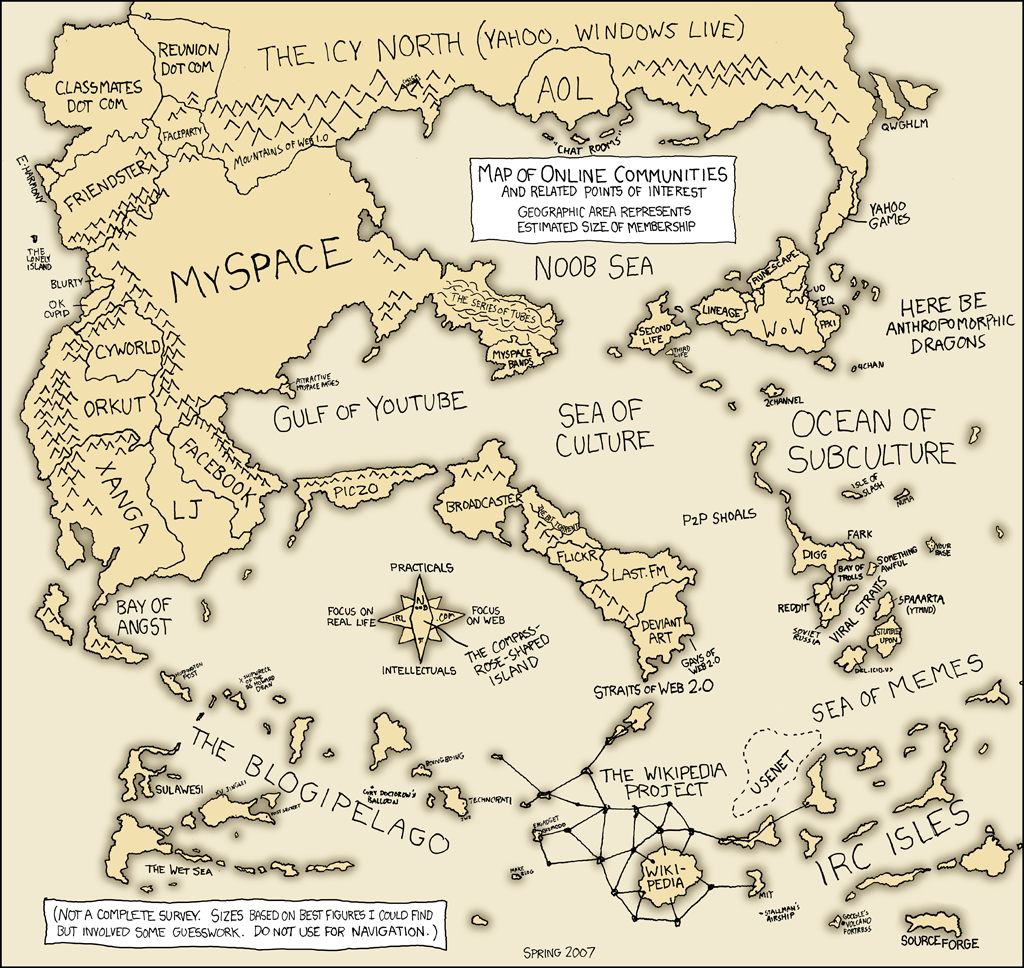
Knowledge map of online communities

Makezine is just a great nerd-hub. This morning i found the visualization of cyberspaces' community landscape. A great example of knowledge visualisation if you ask me.

Ps: i haven't seen any copy-right or -left statements, but - it coming from makezine - i expect that it is ok. to show the pic - i have not even touched it - it comes from the original server.

Saturday, March 17, 2007

digital ethnography & cutting edge sixties

Text is linear by Prof Wesch
is really a great visualization of the change from physical-analog-linear to virtual-digitally-hyperlinked
http://mediatedcultures.net/ksudigg/?p=78


Prof Wesch is working on digital ethnography and in my opinion this is an excellent marketing piece, communicating the relevance and triggering the interest of potential students. Here are some more videos of that course - http://mediatedcultures.net/ksudigg/?cat=4

Powers of Ten
A film dealing with the relative size of things in the universe - and the effect of adding another zero. I dont remember where i read it but i think this movie was shot by IBM in the sixties and that makes it a truly cutting edge piece
http://video.google.com/videoplay?docid=6945724039283018435